
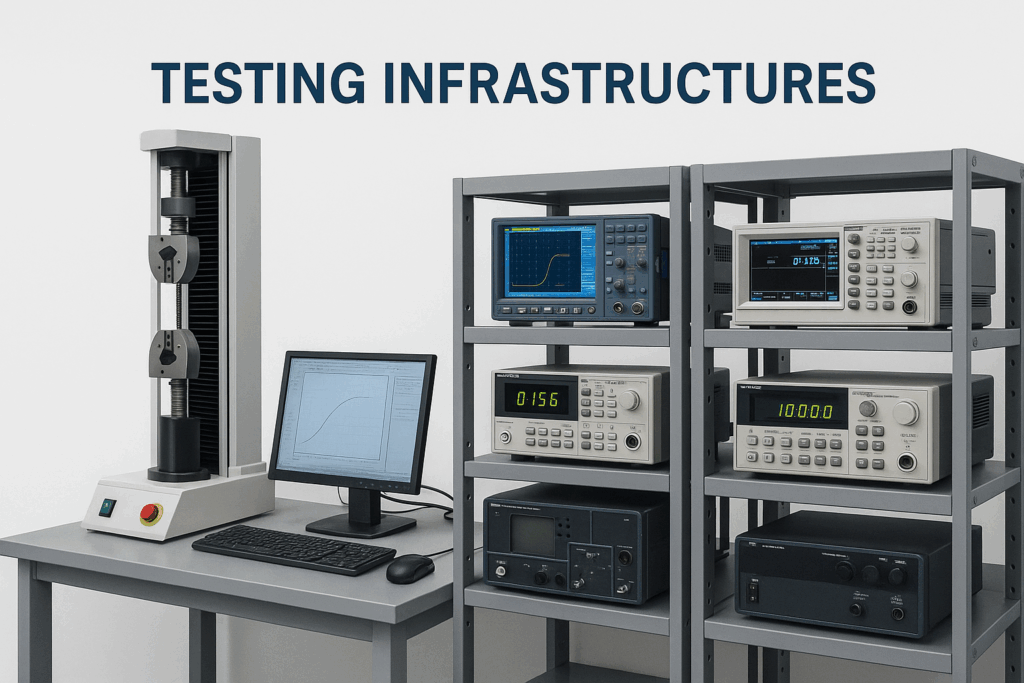
Testing infrastructure in manufacturing—especially for plastic, sheet metal, and electronic components—ensures product quality, durability, and compliance with industry standards. It includes both equipment and processes across mechanical, electrical, and environmental domains.
🔧 Key Components of Testing Infrastructure
1. Mechanical Testing
- Tensile & Compression Testing Machines – Check material strength, elasticity.
- Hardness Testers (Brinell, Rockwell, Vickers) – For component surface resistance.
- Impact Testers – Assess toughness under sudden force.
- Fatigue Testing – Repeated loading cycles to determine life span.
2. Dimensional Inspection
- CMM (Coordinate Measuring Machines) – 3D measurement with micron-level accuracy.
- Profile Projectors & Optical Comparators – For verifying complex part geometry.
- Calipers, Micrometers, Gauges – Manual tools for regular QA checks.
3. Environmental & Thermal Testing
- Thermal Chambers – Expose parts to extreme temperatures to test stability.
- Humidity & Salt Spray Chambers – For corrosion and weather resistance.
- UV & Aging Chambers – Simulate long-term sun and wear exposure.
4. Electrical Testing (for electronic components)
- Hi-Pot Testers – High-voltage insulation testing.
- Continuity & Resistance Testers – For wire harnesses and PCB checks.
- EMI/EMC Testing Labs – Ensure compliance with electromagnetic standards.
5. Plastic Part Testing
- MFI (Melt Flow Index) Tester – Checks viscosity of thermoplastics.
- Shrinkage & Warpage Testers – Ensure molded parts hold their shape.
- Color Matching & Gloss Meters – For visual and finish consistency.
6. Sheet Metal Testing
- Cupping Test – Check sheet formability.
- Bend Test – Confirm ductility and resilience.
- Weld Strength Tests – For spot and seam weld integrity.